For Immediate Release
Accra, Ghana – (November 22, 2025) —
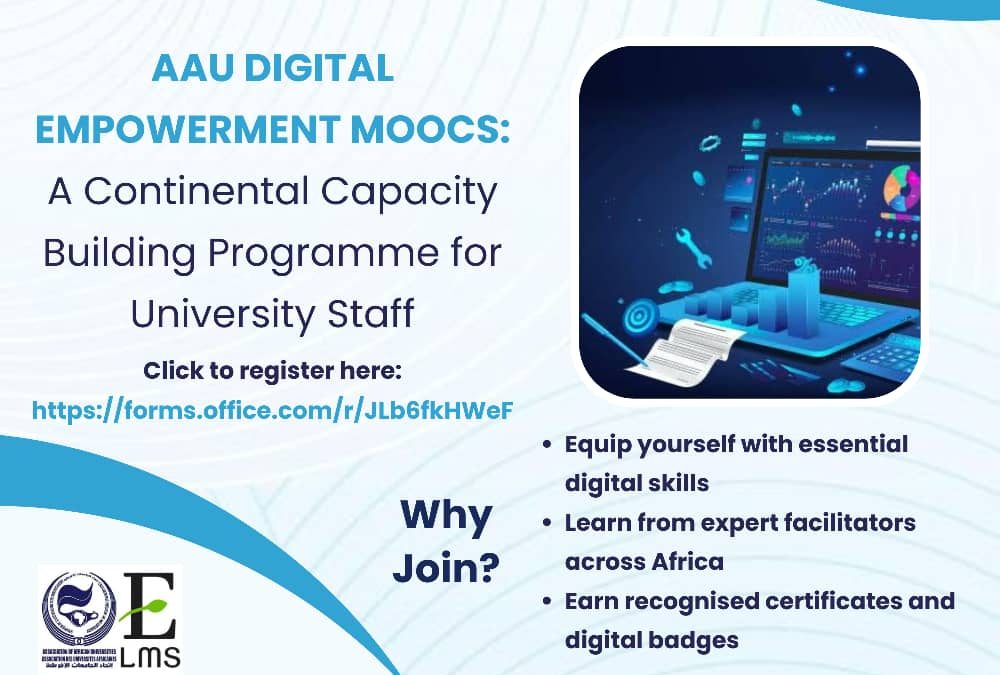
The Association of African Universities (AAU) is proud to announce the official launch of its Digital Empowerment Massive Open Online Courses (MOOCs) Initiative, a strategic intervention designed to propel the technological advancement of higher education across Africa.
The platform was unveiled by the AAU Secretary-General, Professor Olusola Oyewole, on November 14, 2025, during the closing ceremony of the Africa Universities’ Day celebrations. In his address, Professor Oyewole called for a fundamental shift in how universities harness technology, urging institutions to expand their digital capacity-building efforts beyond faculty and students to include administrators and all staff within the academic value chain. This initiative delivers on that vision by providing accessible, scalable, and high-quality training in three critical domains: (1) Cybersecurity Fundamentals for University Systems (2) AI Essentials for Teaching and Administration (3) Digital Literacy for Modern Academia
The initiative is designed to equip university staff across Africa with critical digital skills, strengthen institutional capacity, and enhance the adoption of Artificial Intelligence (AI) and cybersecurity practices in teaching, research, and administration. It forms part of AAU’s broader strategy to strengthen digital competencies among academic and administrative staff across its 450 member universities, supporting the African Union’s Agenda 2063 vision of a knowledge-driven, digitally empowered Africa.
The Digital Empowerment MOOCs will be delivered in a blended format, combining three-week self-paced online sessions with a day’s contact session (virtual) with facilitators, followed by an optional one-week in-person practical workshop to maximize participation and impact.
The first online cohort runs from from February 2 to 20, 2026. Registration for the online sessions is free and can be completed via https://forms.office.com/r/JLb6fkHWeF.
The in-person workshop will take place in April, 2026, at the AAU Secretariat, located on the Trinity Avenue, East Legon, Accra, Ghana It focuses on advanced strategic planning, leadership in digital transformation, and technology adoption. The workshop fee, USD 400, covers facilitation, materials, and meals. Payment can be made via https://pay.aau.org/digital-empowerment-moocs.
Participants will engage in video lectures, interactive simulations, case studies, discussion forums, and capstone projects, enabling practical application of acquired skills. The MOOCs initiative aims to deliver measurable benefits to staff and institutions across Africa, with at least 80% of participants expected to improve proficiency in digital, AI, and cybersecurity tools. It also aims to help institutions to reduce minor cybersecurity incidents by 50% while accelerating AI-driven processes within 12 months. Successful participants will be awarded certificates, enhancing professional visibility and institutional benchmarking.
The programme was designed with subject matter experts, strategic partners, university staff, and ICT directors to deliver practical and contextually relevant content. The AAU is, thus, by this release, inviting university administrators, teaching staff, ICT professionals, students, and sector partners to participate in this transformative initiative. We believe that by building a digitally empowered workforce, African universities will enhance innovation, strengthen operational resilience, and contribute meaningfully to Africa’s long-term development goals.
Please contact aaulms@aau.org for further information.
For Media Enquiries,
Dr. Felicia Nkrumah Kuagbedzi
Email: fnkrumah@aau.org
About the AAU
The Association of African Universities is an international, non-profit, non-governmental organization created by African universities to promote cooperation among institutions on the continent and strengthen their engagement with the global academic community. Founded in 1967, the AAU serves as the voice of higher education in Africa. Its mission is to enhance the quality, relevance, and sustainability of African higher education by supporting institutional development, fostering collaboration, and promoting innovation across the continent.