
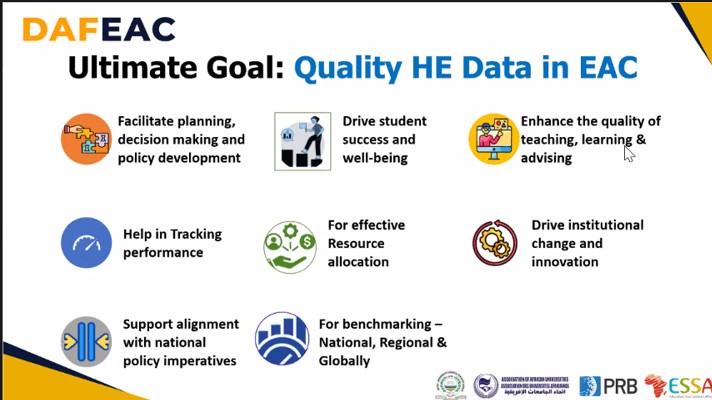
Data is an essential component for effective planning, decision-making, and policy development in higher education. However, across many African universities and higher education commissions, the lack of strong, institutionalized data management systems remains a significant challenge. The absence of reliable infrastructure for data collection often hampers the ability of Higher Education Institutions (HEIs) to monitor performance, plan effectively, and respond to emerging trends. One of the key hurdles faced by these institutions is the fragmented and inconsistent data on faculty across the region, which directly impacts faculty staffing and performance monitoring. This inability to establish reliable data management systems prevents HEIs from making evidence-based decisions and limits their capacity to address the rapidly changing demands of education in Africa. To address these issues, the Association of African Universities (AAU), in collaboration with Education Sub-Saharan Africa (ESSA), the Inter-University Council for East Africa (IUCEA), and the Population Reference Bureau (PRB), launched the Demographics of African Faculty in the East African Community (DAF EAC Phase II) project, running from November 2023 – October 2025. This initiative aims to address significant data gaps, strengthen the capacity of HEIs to manage and collect data, and advocate for the adoption of best practices in data management.
As part of the activities under DAF EAC project, the AAU hosted a webinar on Thursday, 27th February 2025, under the theme: Building Sustainable Higher Education Data Management Systems for Informed Decision-Making. The event featured key stakeholders who discussed the challenges faced by East African HEIs in managing and utilizing data, and the ways forward for addressing these issues.
Ms. Nodumo Dhlamini, Director for ICT Services, Communications & Knowledge Management at the AAU, delivered the opening remarks on behalf of the Secretary-General. She reaffirmed AAU’s commitment to supporting evidence-based policies and advocacy for data management in higher education.
The session was moderated by Dr. Felicia Nkrumah Kuagbedzi, the Senior Communications Officer at the AAU who guided the discussions on the progress and findings of the DAF project.
Dr. Marlene Lee, representing the Population Reference Bureau (PRB) highlighted that the institution was founded in 1929, and has been instrumental in compiling and harmonizing demographic data, providing significant contributions to the development of data management systems in higher education across Africa. Dr. Lee underscored the role of PRB in the current project, stating that the organization has been actively involved in demographic data collection and analysis in East, West, and Central Africa, and has extensive experience working in Kenya.
Dr. Lee also reflected on the pilot phase of the DAF project, which was hosted in Ghana in collaboration with AAU and ESSA. The pilot project focused on aggregating data and developing a base methodology for projecting faculty staffing. Dr. Lee praised the collaboration and how it benefited the East African community, offering valuable insights that informed the current phase of the DAF project. The second phase of the DAF project, running from 2023 to 2025, aims to bridge the data gaps identified in the first phase and develop harmonized guidelines for standardized data collection and management across the region, she added.
Dr. Salome Guchu, Principal Innovations and Outreach Officer at IUCEA, made a presentation titled – DAF-EAC Project – Insights from Phase 1, Progress in Phase 2, and the Path to Harmonized Guidelines. She stated that the study, initiated in 2021 and concluded in 2023, focused on faculty demographics across East African higher education institutions, including faculty numbers, gender distribution, and subject areas. Dr. Guchu outlined the findings, which highlighted critical gaps in faculty availability, gender representation, and adherence to policy norms. These findings, as highlighted, are essential for understanding student-teacher ratios, faculty demands, and future planning for faculty staffing in the region.
A significant issue discussed was the student-teacher ratio, and the implications of this ratio on data gaps in higher education. The conversation also delved into the challenges surrounding data governance at HEIs, specifically the need to address data fragmentation and inconsistency in data standards and definitions. Dr. Guchu identified key challenges in data collection processes and shared key insights from a benchmarking exercise conducted as part of the project. The goal is to establish a framework that improves data governance, ensures data quality, and supports better decision-making in faculty planning. One of the primary challenges in higher education data management, as projected, is the fragmentation and lack of integrity in data systems. Inconsistent data standards and definitions, limited automation, and issues of data accuracy and reliability were discussed as major barriers to effective decision-making.
Associate Professor Robert Wamala, from Makerere University, Uganda, presented strategies to harmonize and institutionalize higher education data collection processes. He discussed the need for a standardized data collection framework and the development of integrated data management systems, which could include the use of digital tools to replace outdated paper-based records. Prof. Wamala emphasized the importance of developing data governance policies and quality assurance mechanisms to ensure that data collected by institutions is reported accurately and appropriately.
The discussion on institutional data policies raised concerns about the absence of centralized data policies and standardized processes across HEIs. A proposed solution is to develop harmonized guidelines that would enhance data accountability and improve decision-making. These guidelines include standardized indicators, data sources, and collection methods, which are crucial for planning, resource allocation, and tracking faculty and student performance metrics. Additionally, the importance of engaging stakeholders in the process was emphasized, particularly in terms of involving faculty and administrative staff in data collection and analysis.
The challenges related to data integration and fragmentation were further explored, with suggestions made for creating a centralized data framework that would streamline institutional reporting. The integration of digital tools and the adoption of data-driven decision-making practices were identified as key solutions to address these issues. A case study from Makerere University, showed the MakData centralized dashboard, as a successful example of data integration. Starting in 2023, this project serves as a model for the East African Community (EAC), offering valuable lessons on overcoming data fragmentation and enhancing institutional management. The closing remarks were made by Ms. Joan Akua Iyoha, Project Officer for the DAF EAC project at the AAU, who acknowledged the contributions of various stakeholders and project partners , in advancing data management in higher education. Participants were encouraged to take proactive steps towards establishing robust data management systems, which would aid in data-driven decision-making in their institutions. The DAF Project has made significant strides in improving data management in East African higher education institutions. The ongoing second phase of the project, funded by the Carnegie Corporation of New York, is focused on addressing critical data gaps, promoting best practices, and fostering stakeholder collaboration.
The webinar reinforced the importance of sustainable data management systems to support informed decision-making, enhance faculty planning, and contribute to the long-term sustainability of higher education in the region. With continued efforts, the DAF project is poised to play a transformative role in shaping the future of higher education data management across Africa